

Bold outline monarchs often outlast the dainty single-needle pieces that flood feeds. A monarch needs contrast to read as a monarch, and tiny vein work can blur into an orange smudge after a few years. If you care about species recognition, color saturation, and placement that actually holds up, these 25 traditional Monarch Butterfly tattoo approaches focus on scale, linework, and wardrobe choices that keep the design visible without shouting.
1. Classic American Monarch on Outer Upper Arm
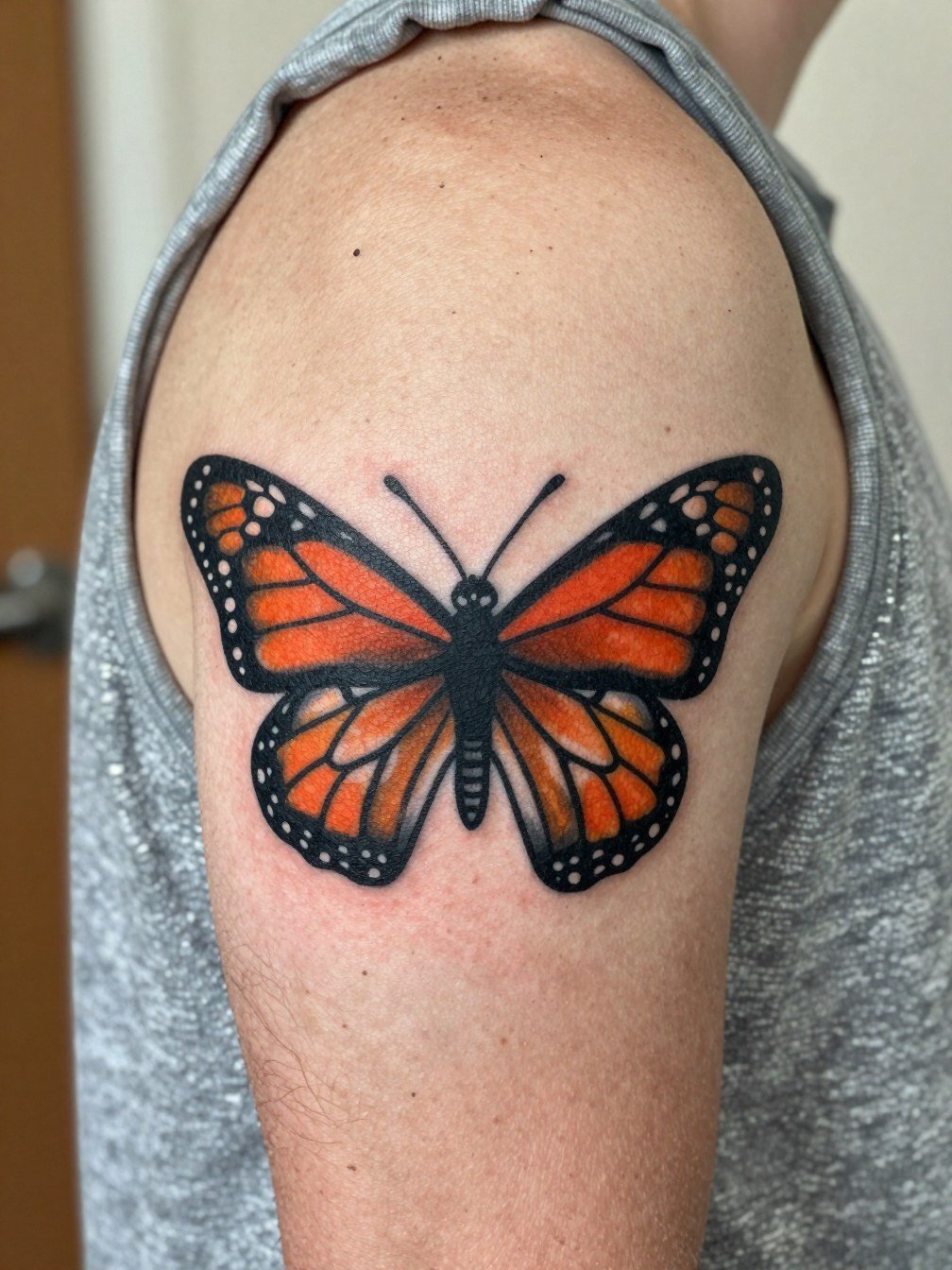
The classic American traditional monarch reads instantly because of thick black linework and heavy saturation. Choose this version if you want the species to show from a distance and hold clarity over time. Tell your artist to set line weight slightly heavier than a typical fine-line reference so wing veins and antennae stay distinct at year two and beyond. A common mistake is shrinking the flash to a palm-sized sticker, which collapses the orange panels into a muddy patch after healing. Session time is usually one hour for a small-to-medium outer arm piece. For showing it off, pair the placement with a vintage tank top that keeps the shoulder visible, and wear a loose short-sleeve tee to the appointment so the stencil sits flat.
2. Neo-Traditional Monarch with Shoulder Cap Florals
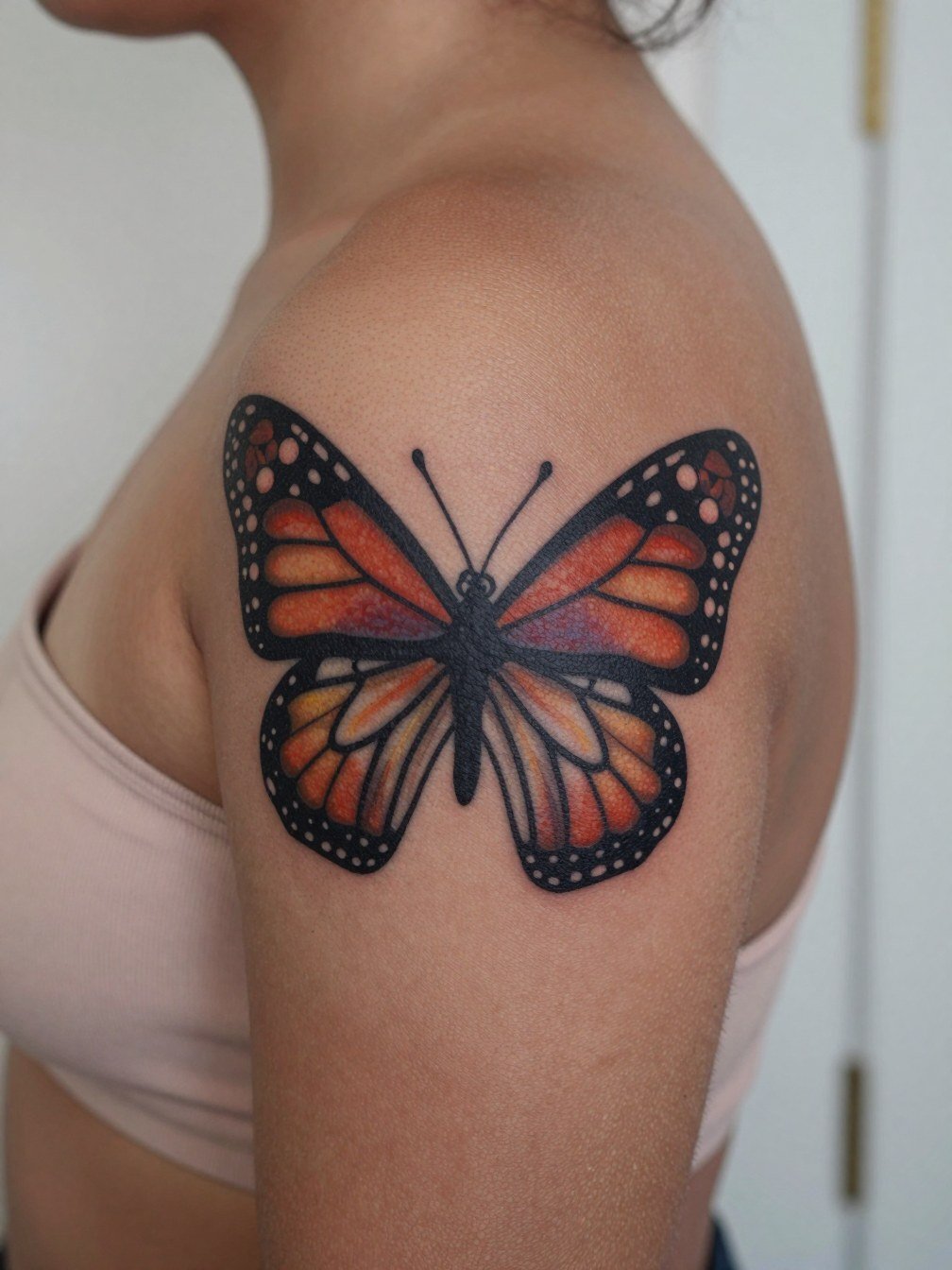
This neo-traditional take adds dimension without sacrificing the traditional silhouette. Pick this when you want more depth and floral framing that follows the shoulder curve. Ask the artist for moderate saturation and layered stipple shading so the flowers keep texture without competing with the monarch wings. The version that ages poorly crams tiny petal detail into a small cap and loses definition, so plan for slightly larger floral elements. Expect one to two sessions depending on complexity. To frame it in everyday outfits try an off shoulder top that mirrors the shoulder curve and highlights the composition.
3. Monarch with Marigolds for Día de los Muertos-Adjacent Composition
This composition honors the Monarch's cultural link to ancestral-return seasons without leaning on vague symbolism. If you want the Día de los Muertos feel, include marigolds and let the flowers wrap slightly around the wing tips so the story reads from either side of the forearm. When you bring references, show the artist healed photos that demonstrate marigold petal spacing so the orange stays distinct. A frequent error is over-detailing tiny petals near the wrist, which blurs under frequent movement. One session can handle a medium outer forearm piece. For daily wear try rolled sleeves or a rolled cuff shirt to keep the forearm visible and let the marigold colors pop.
4. Small Flash Monarch for the Wrist
Wrist pieces are low-commitment but they face high friction and sun exposure. If you want a small monarch that lasts, avoid ultra-fine internal veins and ask for a slightly bolder edge so the wing pattern does not mush by year two. The most common mistake is treating the wrist like a canvas for tiny detail. Expect a single short session and plan for a touch-up around the one-year mark for color tops. For styling, keep bracelets to the other wrist and wear a minimal watch or thin bracelet on the opposite arm so the tattoo reads cleanly when you gesture.
5. Behind-the-Ear Monarch, Tiny and Private
Behind-the-ear monarchs feel very personal but they are high on visibility for hair decisions and low on surface area. For longevity, keep the internal detail minimal and rely on clear outer contours. Note that this placement can be a little more sensitive because of thin skin over bone, so expect a quick but sharp session. A typical mistake is asking for tiny stippled veins; the area will lose them faster than the arm. Bring a hair clip and wear a silk hair tie so the artist has a clean field and you can style it up immediately after.
6. Fine Line Monarch on Inner Forearm
Fine line looks modern on the inner forearm but it requires compromise. If you want a delicate feel yet still want species recognition, ask for slightly wider vein spacing and stronger outer linework so the orange fields do the heavy reading. The common failure is a straight single-needle trace that disappears into skin texture by year two. Discuss expected sizing with the artist and plan for a one-year touch-up to refresh saturation. Avoid heavy stipple inside filigree at this scale. For outfits, push sleeves up and pair with a linen button down in cream or olive for an editorial look that keeps the inner forearm visible.
Studio Day Picks
These first six placements vary in friction and sun exposure, so a few small items smooth the session and the first week of healing.
-
Fragrance-free antibacterial wash. Gentle cleansing is the first defense against infection and reduces irritants that can muddy orange pigments on color work.
-
Light-texture tattoo aftercare ointment. A thin healing ointment keeps fine-line pieces hydrated without smothering needle channels and minimizes scabbing.
-
Thin protective film roll. Use for short initial coverage on wrist or finger placements that face constant hand washing.
-
Fragrance-free lotion. A simple lotion is a reliable follow-up after the first few days when heavier ointments feel too occlusive.
-
SPF 30+ mineral sunscreen. Once healed, daily sun protection preserves orange saturation and slows early fading.
7. Realistic Monarch on the Calf
Realism sells species recognition, and the calf gives enough real estate for crisp wing patterning. Opt for medium scale so the white edge dots can stay crisp. Ask the artist to map the wing panels at full scale before shading so the orange fields do not bleed into one another during healing. The error people make is squashing a realistic reference into a postage-stamp size. Session time is typically one to two hours. For warm months, show the work off with cropped straight jeans that end above the calf.
8. Blackwork Monarch Silhouette on Outer Thigh
If longevity is your priority, pure blackwork shrugs off color fade and keeps a bold graphic read. Choose a silhouette if you want a statement without color maintenance. When planning, specify filled-black ink across the wing panels and reserve thin white highlights if you want contrast without color. A common misstep is tiny inner details that the thigh cannot resolve at distance. One session usually does it. For outfits try high waisted shorts or bike shorts that display the bold shape cleanly.
9. Monarch with Banner or Script Underneath on Upper Arm
A banner grounds a traditional monarch and gives space for a date or short word. Keep the banner low and bold so the added text does not compete with wing detail. When you show references, include the exact short word or date you want so lettering can be sized to fit the band. People often cram long phrases into narrow banners which ends up unreadable after a year. Expect a single session for a small upper arm piece. Pair the placement with a rolled sleeve henley to highlight the banner when you lift your arm.
10. Monarch Paired with Sunflower on Outer Forearm
Sunflowers boost the Americana vibe and frame the Monarch for a fuller sleeve-friendly piece. Ask for clear negative space between the wing edges and petal tips so the orange holds its own. The common error is overlapping tiny petals into wing panels, which blurs in heavy-motion areas. Usually one session handles a medium forearm composition. Show it off with a utility overshirt or a clean short sleeve to keep the forearm visible.
11. Tiny Monarch on the Ankle
Ankle tattoos face friction from socks and shoes so keep the design a clean silhouette and avoid intricate internal veins. Plan for a slightly bolder outline than you might for a wrist piece because the ankle trades finer detail for longer-term readability. The typical mistake is over-saturating tiny color fields that dull from shoe contact. Single-session work usually. Style with cropped pants or slit midi skirts to show the piece without rubbing it in boots.
12. Upper Chest Monarch Below the Clavicle
The collarbone area flatters a centered monarch because the wing shape complements the clavicle line. Request symmetry checks in stencil and ask the artist to show how the wing tips sit with shoulders raised and lowered so it reads at rest and in motion. Mistakes to avoid include placing the design too low so it gets lost under necklace chains. Expect one to two sessions depending on size. Wear a scoop neck top to highlight the piece after healing.
13. Side Torso Monarch for Private Placement on the Ribcage
Ribcage placement follows the body's curve and can feel intimate, but the skin moves a lot so design choices matter. If you want this spot, scale up slightly and prioritize strong outer linework so the wing pattern does not pool in movement zones. A common complaint is asking for a tiny fine-line monarch at the ribs and being disappointed when internal detail blurs. Plan for one to three sessions depending on size. For session comfort, wear a loose bra or easy no-wire option and bring a drawstring short to avoid waistband pressure after inking.
14. Monarch with Sun-and-Moon Pairing Across the Chest
Pairing celestial elements gives a traditional composition additional symbols without crowding the wings. When planning, size the sun and moon small enough to act as accents so the Monarch still reads primarily as the subject. Avoid filling the chest with competing detail that distracts from the wing silhouette. Session time is commonly one to two hours. For outfits, an open collar shirt frames this area and shows the symmetry.
15. Micro-Realism Monarch on the Back of the Neck
The nape can hold surprising detail if the piece is executed at an appropriate scale. For a micro-realism look, ask for emphasis on edge contrast so white dots and black margins remain distinct after healing. The mistake is compressing too many internal markings into a tiny patch. Expect a short session with careful needle control. For visibility, wear a high ponytail or use a hair claw clip to keep the area exposed when you want to show it off.
16. Stylized Geometric Monarch Overlaid with Dot Work
Geometric overlays modernize the Monarch while keeping a clear silhouette. Use stipple shading sparingly so dots do not coalesce into tone in high-friction zones. A typical error is overfilling the wing interiors with micro-dot gradients that blur with movement. One session should suffice for small-to-medium forearm overlays. Pair with rolled sleeves or a neutral short sleeve tee for an editorial display.
17. Monochrome Black and Gray Monarch on the Inner Arm
Black and gray keeps the Monarch recognizable through silhouette and texture while avoiding color maintenance. Choose this if longevity and low upkeep matter more than species-accurate orange hue. One mistake is keeping inner linework too fine, which particularly blurs along the inner arm where skin creases. Expect a single longer session for tonal gradients. For session wear, a loose tank top lets the artist access the medial bicep cleanly.
18. Monochrome Silhouette Small on the Wrist with Negative Space Veins
A silhouette with negative-space veins reads well at micro sizes because the design relies on contrast rather than fine internal strokes. If you want a small wrist piece that keeps identity, this is a durable choice. Avoid tiny hairline veins that the wrist will erase. Plan for a quick touch-up at the six to twelve month mark to keep the black dense. Style with cropped sleeves and minimal wrist jewelry for a clean look.
19. Monarch with Decorative Dotwork Halo on the Calf
Dotwork halos add an ornamental frame that keeps the Monarch focal without adding competing color. When commissioning this, specify dot size and spacing so the halo maintains texture without turning into a gray wash at year three. A frequent oversight is too-dense dot fields that merge. One session can handle the layout and fill. Show it off with loose shorts or cropped jeans that reveal the calf.
20. Healed-Look Monarch Designed for Darker Skin Tones
Monarch legs and wings can read differently across skin tones, so request contrast-first planning. Ask for heavier outer linework and saturated pigments so the orange reads against richer skin. The mistake is copying a light-skin reference and expecting the same visual pop. Expect standard session timing. For showing the design off, short sleeves or rolled cuffs keep the forearm visible and let color contrast do the work.
21. Single-Wing Monarch Accent Behind the Ear or on the Collarbone
A half-wing suggests the motif without committing to full symmetry and works well in subtle places. For mastoid or collarbone, plan for a bolder sweep on the wing edge so the fragment still reads as a Monarch. The common mistake is trying to cram full wing detail into a small fragment. Sessions are quick. For wear, a wide neck tee or hair updo keeps the accent visible.
22. Monarch with Marigold Wrist Wrap
Wrist wraps give the monarch a continuous visual that resists blurring because the design uses larger color fields. Keep the marigold petals simple and avoid tiny filigree within the wrap that will soften quickly. A typical error is wrapping too tightly with tiny leaves. Expect a single session and plan for a light touch-up at the one-year mark. Style with cropped sleeves and minimal wrist jewelry for maximum visibility.
23. Minimalist Monarch Outline on the Ankle or Nape
Minimal outlines feel quiet and modern but they demand honest sizing and placement choices to avoid disappearance. For ankle or nape, keep the outer contour slightly thicker than a fine-line chest script so the silhouette stays readable. The mistake is using a single hairline trace on mobile skin. One short session is common. For footwear and clothing, cropped pants or neck-exposing tops work best.
24. Monarch with Stipple Shading and Subtle White Highlights on the Thigh
Stipple shading gives texture that ages into character when executed with spacing in mind. Ask the artist for dot size that stays intact across the thigh's movement and avoid overdoing white highlights close to the wing edge. A common error is placing tiny white dots that fade into the skin over time. One session for medium thigh pieces. Pair with midi skirts that reveal the top of the thigh artistically.
25. Monarch Designed for a Sleeve Anchor on the Outer Forearm
If you plan a sleeve, treat the monarch as an anchor that needs breathing room for adjoining pieces. Discuss negative-space corridors and where floral or geometric add-ons will connect so future elements do not crowd the wing. A common mistake is placing an anchor too close to an elbow crease where it deforms with repeated motion. Expect one to two sessions for a forearm anchor. For sessions, bring a loose button-down that can be removed without compressing the arm.
Frequently Asked Questions
Q: How do I pick between a fine-line Monarch and a bold traditional version?
A: Artists split into two camps on this choice. One camp favors fine-line because it feels modern and delicate on visible spots like wrists or inner forearms. The other camp favors bold traditional work because it delivers contrast that helps a Monarch keep species identity and resist blur. Decide by prioritizing what matters more to you: immediate aesthetic or long-term readability, then size the design accordingly.
Q: Should I get a color Monarch or black and gray?
A: Two clear positions exist. Color supporters say the orange-and-black palette is essential for a Monarch to read as a Monarch. Black-and-gray supporters say monochrome is easier to age and touch up and can look more cohesive across other blackwork pieces. Consider a midground option such as black outlines with selective orange washes so you get species cues with improved longevity.
Q: Where can I find portfolios and healed examples without naming specific artists?
A: Use hashtags like #monarchbutterflytattoo, #traditionaltattoo, and #neotraditionaltattoo on Instagram and TikTok and filter by location to surface local portfolios. Reddit tattoo communities and tattoo-specific forums are useful for seeing healed photos and real-world aging. For reliable results, prioritize portfolios that show both fresh and healed shots and look for healed images across different skin tones.
Q: How much does a traditional Monarch butterfly tattoo cost and how should I budget?
A: Prices vary by size and style and shop minimums matter. Expect smaller flash pieces to fall into lower shop minimum ranges while custom color or multi-session neo-traditional work runs higher. Tip based on shop norms and the session quality, and plan for potential touch-ups in the first year if you choose detailed color fills.
Q: What aftercare will help orange saturation hold up best?
A: Gentle washing with a fragrance-free antibacterial wash during the early healing window, thin layers of a light-texture aftercare ointment for the first few days, and then a fragrance-free lotion until fully healed protects color without clogging. After healing, daily sunscreen use on exposed tattoos preserves orange saturation long term.
Q: Are there placement-specific pain or healing concerns I should know about for these Monarch ideas?
A: Yes, some placements are more sensitive. The ribcage and sternum typically score higher on pain charts because they sit over bone and move with breathing. Wrists and ankles face extra friction and washing. Plan for session comfort by wearing loose, low-friction clothing to the appointment and expect touch-ups sooner on high-friction sites.
Q: Can these Monarch designs be adapted for different skin tones?
A: Absolutely. For darker skin tones, request higher contrast outlines and richer pigment saturation so orange fields remain visible. For lighter tones, subtle white edge dots can enhance realism. Ask to see healed examples on similar skin tones so you can visualize long-term results.
